We have received the following report from the University of Cambridge, which summarises the progress made following the award of a Lewy Body Society grant in 2015. There are some very positive outcomes, such as an improved understanding of imaging biomarkers in people living with Lewy body dementia, the recruitment of people living with LBD […]
This information about research methodology was shared at the International Mental Health Nursing Research Conference by Allison Bentley, Lead Research Nurse for Lewy body dementia at Cambridgeshire and Peterborough NHS Foundation Trust. This is part of a study funded by The Lewy Body Society focusing on the narrative stories of people living with Lewy body […]
Study Title: The feasibility and acceptability of a psychosocial intervention to support people with dementia with Lewy bodies and family care partners We have received an update from Newcastle University about a study that was supported by The Lewy Body Society, which we wanted to share with our supporters. Background Clinicians and people with lived […]
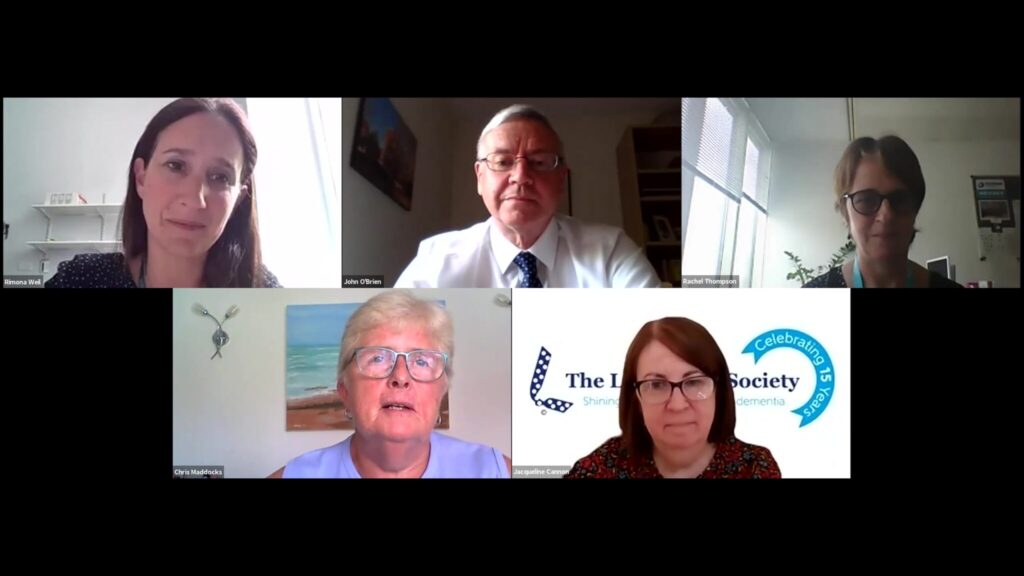
We were delighted to work with a team of academics – Rimona Weil (UCL), Claire O’Callaghan (The University of Sydney) & John-Paul Taylor (Newcastle University) – to host the Lewy Body UK 2021 Scientific Conference on 15th June. With 15 speakers in total, some from as far away as Australia and the USA, it was […]
Associate Professor Jay Amin spoke about his research on a Zoom webinar on Tuesday 1st December. The recording of the event is available on our YouTube channel here. Two newly published research studies, led by Dr Jay Amin from the University of Southampton and supported by the Lewy Body Society and Alzheimer’s Research UK, have […]
By Shivani Patel and Jiabin Tang To download this article as a pdf please click here. Introduction Recently, all our lives have been turned upside-down by the Coronavirus (COVID-19) pandemic. In this article we will describe the impact of the pandemic and the resultant ‘lockdown’ on people living with Lewy body dementia, and how the […]
In this article, researcher Alison Killen describes a new support group she has established for people living with Lewy body dementia and their families, and why she wants these groups to be available in all areas. I work as a researcher at Newcastle University and I am also training to be a health psychologist. My […]
Grants awarded by dementia charity to drive forward diagnosis and treatment The Lewy Body Society, a charity dedicated to tackling the second most common form of dementia, has announced the latest recipients of its grants programme. The charity is awarding three grants totalling £366,000 for projects at the University of Cambridge, Newcastle University and Kings […]
2019/20 Grant awarded to Dr Li Su, ARUK Senior Research Fellow, Department of Psychiatry, University of Cambridge. Study also supported by Windsor Research Unit, Cambridgeshire and Peterborough NHS Trust Aim of the study To use new imaging technologies to compare brain structure and function among people with mild-cognitive impairments, to try to identify which patients […]
2019/20 Grant awarded to Dr Oleg Glebov, Lecturer in Old Age Psychiatry, King’s College London Aim of the study To use high-resolution, advanced microscopy methods to study the degeneration of brain synapses. This will further our understanding of the causes of dementia, and help to identify possible ways to treat it. Description of the study […]