
The Lewy Body Society was founded in 2006 by Ashley Bayston, then a practising barrister, after she was shocked to discover how little information existed about Lewy body dementia while caring for her recently diagnosed mother.
When it became clear that no one was championing this disease – with its unique and complex symptoms and so few treatment options – Ashley took matters into her own hands, reaching out to experts across the field.
One of the first people she turned to was Professor Ian McKeith, recognised worldwide as the leading expert in Lewy body dementia. Ian had put the disease on the scientific map, leading the consortium that defined its diagnostic criteria and serving as Professor of Old Age Psychiatry at Newcastle University for many years. He became Emeritus Professor in 2022.
Ashley travelled to Newcastle to meet him and together they founded the charity. Ian became the society’s first President and a founding member of the Specialist Advisory Committee – a role that set the tone for everything that followed.
We launched as an official charity in June 2006 – the first charity in Europe to focus exclusively on Lewy body dementia.
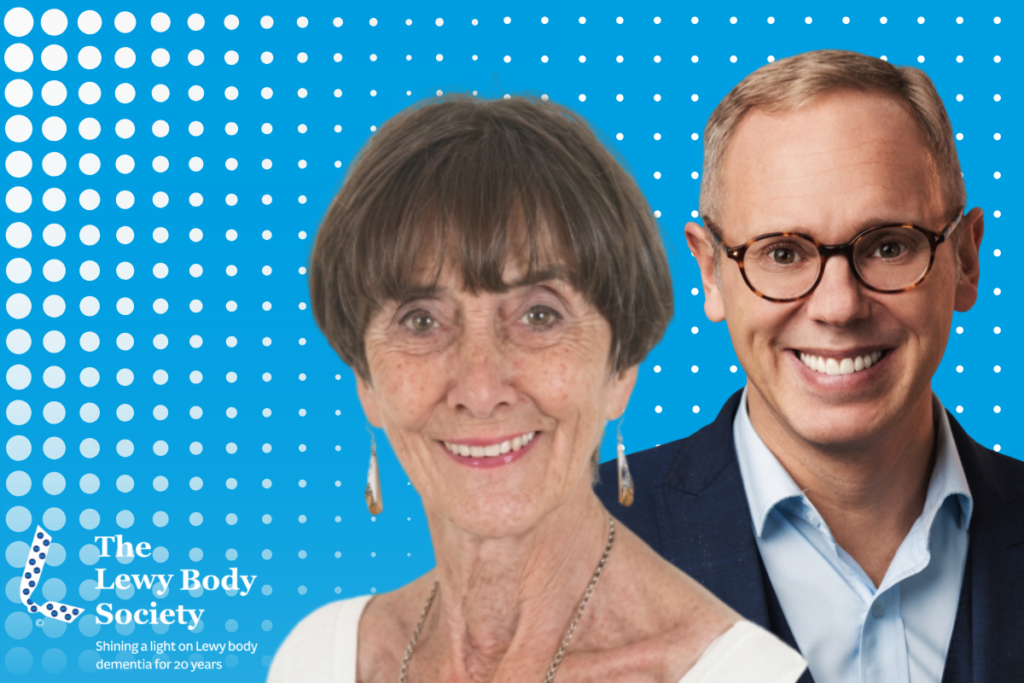
In June 2007, we marked our first birthday with a formal dinner at the Reform Club in London. Ashley had invited actress June Brown OBE – best known as Dot Cotton in EastEnders – whose late husband Robert Arnold had lived with Lewy body dementia. June asked if she could become our Patron. The evening raised around £25,000 – a landmark for a charity just one year old.
June was a passionate and tireless advocate for the Society right up until her death in April 2022.
In 2025, TV presenter, author and barrister Robert Rinder MBE became our Patron, bringing fresh energy and determination to ensure that people with Lewy body dementia are not left behind by society, the medical profession, or government.
We funded our very first research grant – a PhD studentship at Newcastle University – in 2007. The recipient was Dr Marzena Kurzawa-Akanbi, who has since gone on to become a Lecturer in Regenerative Medicine and Principal Investigator in Molecular Neuroscience at Newcastle University’s Biosciences Institute. It was a small beginning that would grow into something significant: to date, we have funded £3.4 million in research across 27 projects at universities throughout the UK.
Central to the charity’s growth has been Jacqui Cannon, our Chief Executive. Jacqui first became involved in 2008 as a volunteer, giving her time whilst continuing her career as an IT business analyst – a role she maintained for nine years as she became an indispensable part of everything the society did. Nine years ago she made the leap to lead the charity full time, a decision driven by deep personal experience: Jacqui was a carer for her father, who lived with Lewy body dementia.
Under her leadership, we have been transformed in scale and reach. Jacqui is hands-on across every aspect of the charity’s work – as well known to researchers and medical professionals as she is to the families and carers who turn to us for support.
Decision-makers in Parliament, clinicians on the front line, and people living with a diagnosis all know her by name. Her ability to connect across those worlds – and to make each person feel seen and heard – is at the heart of what makes the Lewy Body Society what it is today.
Over 20 years, an estimated £8million has been raised by our supporters, fundraisers and partners – every pound of it directed towards our mission of raising awareness and funding research. We have answered around 8,500 calls from families and carers, and sent out more than 2,000 information packs to people navigating a diagnosis.
Around 30 experts have served on our Specialist Advisory Committee over the years, and our first ambassador, Peter Ashley – a person living with a diagnosis – joined us in the very first year. Our community of supporters, researchers and families continues to grow.
We first took our cause to Parliament in 2016, when we secured a Westminster Hall Debate followed by a drop-in event for parliamentarians in the Churchill Room. Since then, we have built a consistent presence at the heart of decision-making.
For four consecutive years, we have been the only dementia charity to take part in Carers UK’s Carers Week – attending drop-in events at Portcullis House with carers from our community, and on one occasion being welcomed to a reception at 10 Downing Street.
In 2022, we launched one of our most visible and joyful campaigns: A Scarf for Lewy. Knitters from across the world contributed scarves that, when joined together, wrapped the Royal Albert Hall not once but six times.
Around 100 people gathered on the day to hold the scarf aloft – a vivid and moving demonstration of just how many lives are touched by this condition. We repeated the event at landmarks in Belfast and Manchester and in 2027, the Scottish capital will feel the warmth of a Scarf for Lewy.
Also in 2022, we launched Lewy Body International – a global network bringing together organisations working to raise awareness and support people with Lewy body dementia worldwide. We are proud to be its host organisation.
In 2024, we launched World Lewy Body Day on January 28, the birthday of Dr. Friedrich Lewy, who discovered the condition in 1912.
In 2026, we mark 20 years of shining a light on Lewy body dementia. To celebrate, we launched a £500,000 research funding call and held a landmark World Lewy Body Day event in Parliament.
We premiered a new short film, held an anniversary dinner at a historic private members’ club in London, only the second charity-organised fundraiser in our history, and brought our celebrations home to Wigan to mark the occasion with local supporters, partners and dementia families.
We remain, as we have always been, a small charity with a global reach – and an unshakeable belief that no one living with Lewy body dementia should be left behind.