
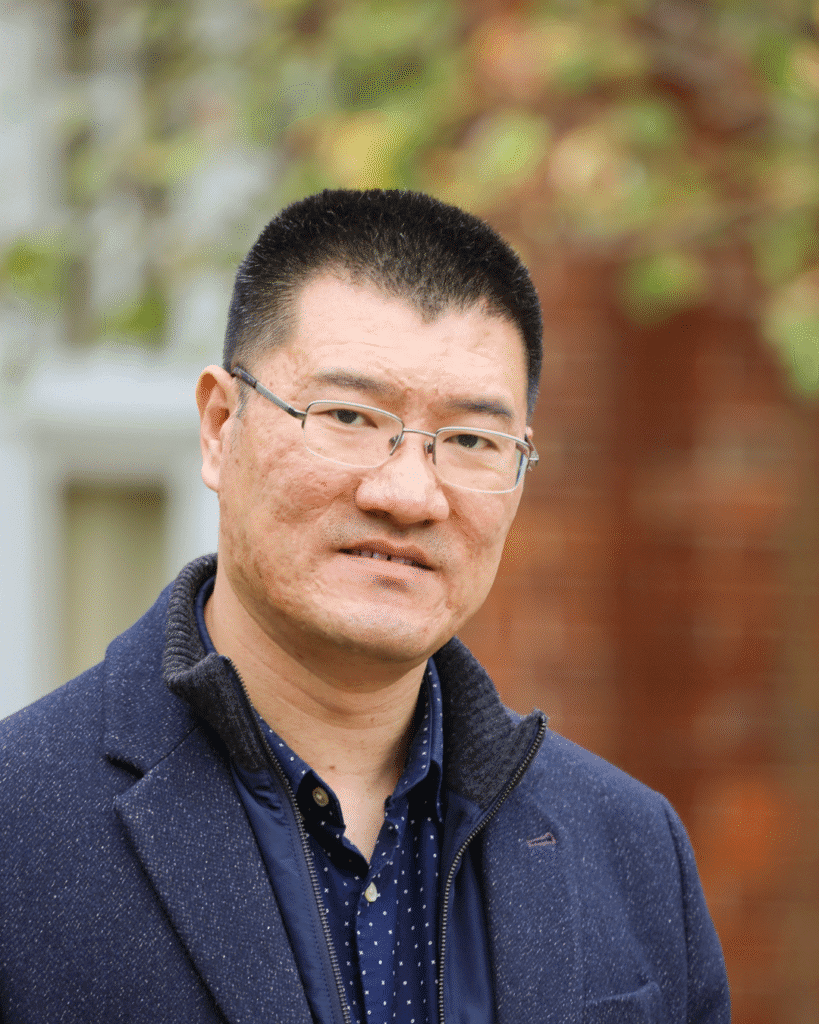
We are delighted to share the news that long-standing Lewy Body Society grant recipient, Professor Li Su, has been appointed as Professor of Neuroimaging at the University of Cambridge.
Professor Su has been supported by the Lewy Body Society for over a decade, receiving more than £300,000 in research funding. His pioneering work has significantly advanced our understanding of dementia with Lewy bodies (DLB), especially through the use of advanced imaging techniques.
Reflecting on the role of the Lewy Body Society in his career, Professor Su said: “I have to thank LBS for giving me my first ever grant ten years ago and for their continuous support until today.”
That first grant set Professor Su on a research path that has since grown into a major programme, with international collaborations and lasting impact.
He explained: “Since 2015, I have received just over £300K from LBS, including one of my very first grants as principal investigator. At the time, I was a senior postdoctoral researcher under Professor John O’Brien, a world-leading scientist in DLB. John was a great mentor, giving me support and freedom to develop my own research programme on multimodal imaging in DLB.”
A central focus of Professor Su’s research is developing early imaging biomarkers for DLB and exploring how these might be used to discover future treatments. One of his early LBS-funded projects investigated whether brain activity in people with DLB differs from that of people without dementia, or those with Alzheimer’s disease. This involved the use of magnetoencephalography (MEG), a cutting-edge technology that provides real-time images of the brain as it processes information.
He explained: “Before we began this study, only one similar project had ever been conducted worldwide – back in the 1990s, with just a handful of patients. By funding our work, LBS was pioneering this approach and its application in DLB.”
Further funding from LBS enabled Professor Su’s group to extend their studies to people with mild cognitive impairment (MCI), thought to represent an early stage of dementia. This work was so timely that the research criteria for MCI due to Lewy body disease were formally published only a year after the study began.
Today, Professor Su and his team are close to completing a landmark multimodal imaging project, collecting MEG, MRI, and PET data from more than a hundred participants with DLB, Alzheimer’s disease, and MCI, alongside annual follow-ups on cognition.
“Many students and postdoctoral researchers are now working with this data, and will continue to do so for years to come,” he said. “We hope it will unlock vital insights into how to detect and manage the unique and troubling symptoms of DLB.”
The support of the Lewy Body Society helped Professor Su to secure further major funding, including a senior research fellowship from Alzheimer’s Research UK. In the past decade, his career has progressed rapidly, culminating in full professorships at both the University of Sheffield and the University of Cambridge.
“The grant from LBS in 2015 started it all – taking me from a young researcher to a professor leading large multi-centre projects in just a decade,” he added
Jacqui Cannon, chief executive of the Lewy Body Society, said: “We are incredibly proud to have supported Professor Su throughout his journey. His achievements demonstrate the impact that targeted funding can have, not only on advancing scientific knowledge but also on nurturing the careers of talented researchers. This is exactly why the Lewy Body Society exists – to make a difference for people affected by DLB by driving forward world-class research.”