

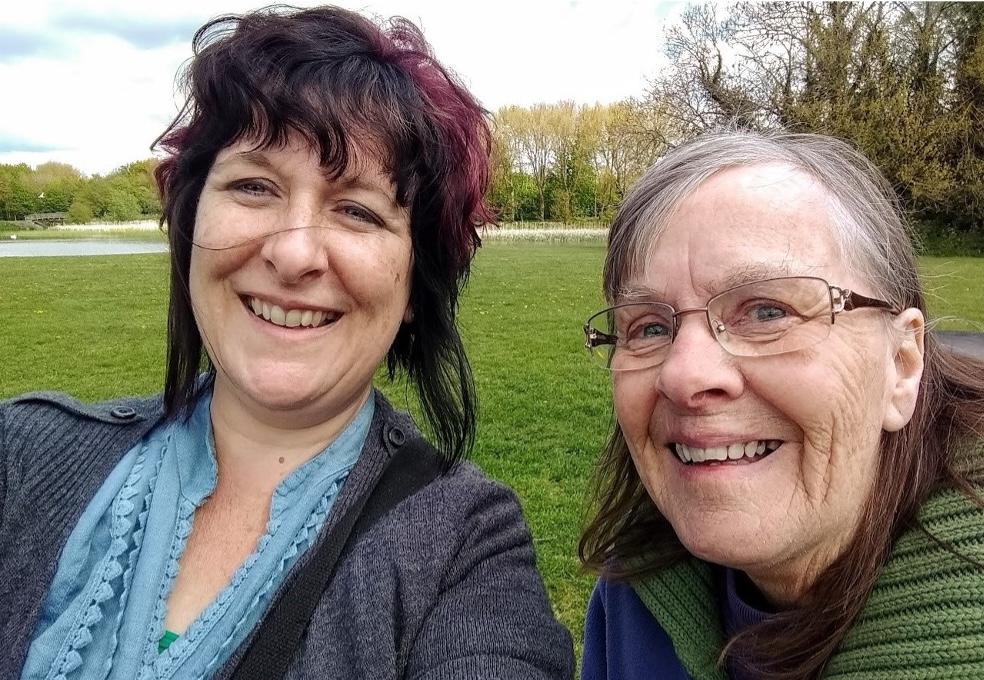
Louise Yates spent six years caring for her mum Marion through Lewy body dementia. It was exhausting, isolating and, at times, frightening. It also left her with knowledge she believes should be used to help other families.
Marion died earlier this year. Louise is still grieving, but has vowed to take what she learned caring for her to help others living with dementia.
Her mum needed support with every part of daily life. As her dementia progressed, she experienced hallucinations, panic attacks and swallowing difficulties. Louise had to puree her food, thicken her drinks and watch closely in case she choked. Louise gave up her career, and spent almost every waking moment by her side.
“I cared for her 24/7 to keep her safe. I was with her at her home when she was awake, usually around 13 hours a day. When I went home just round the corner, I had cameras and motion sensors in place so that I could monitor her and would return throughout the night when I was needed,” she said.
“I was absolutely exhausted. Not just physically, because she couldn’t swallow, changing her and the bed and all the washing, but mentally, because she was just shouting for me all the time. Even if I did get a few minutes by myself, in my head I could still hear her calling out.”
Lewy body dementia can affect thinking, movement, sleep and behaviour. Some people experience visual hallucinations, changes in alertness, problems with movement and sensitivity to certain medications. The symptoms can be hard to understand and hard to explain to people who have not lived with them.
Louise said some days she would not speak to anyone apart from her mum. She relied on her husband to bring her mum’s shopping and leave it on the doorstep because she could not leave Marion alone.
“I hadn’t been to a shop for six years,” she said. “The last time I went, you put your card in the machine. I didn’t realise you could tap it.”
Hallucinations were one of the first signs that made Louise think Marion might have Lewy body dementia. She had seen similar symptoms in her grandmother, who was diagnosed with paranoia many years earlier, when Lewy body dementia was far less recognised.
“I thought it was Lewy body because I recognised it from my nan,” said Louise. “Because of the hallucinations, really.”
Louise’s grandmother was treated in a secure unit, where staff were trying different medication. Louise believes, although it was never formally confirmed, that her grandmother may also have had Lewy body dementia.
When Marion became ill, Louise began reading more about the condition. Information from the Lewy Body Society helped her understand that some people with Lewy body dementia can have severe reactions to certain antipsychotic medication.
That knowledge became important when Marion was later prescribed medication for symptoms doctors initially thought were linked to Ménière’s disease. Louise checked the notes, recognised that the drug was one she had read people with Lewy body dementia should avoid, and went back to the doctor.
“Make sure medical staff know,” said Louise. “Don’t assume that the medical staff understand.”
Marion’s father had Alzheimer’s as well. With so much dementia in the family, Louise decided she wanted to take action.
“Before Mum lost capacity, I asked her if she wanted to help other people living with dementia, and she said she did,” said Louise.
Together, they shared their story in the media to raise awareness. It led Louise to campaign for better dementia support in their local area. She founded the Peterborough and Cambridgeshire Dementia Panel, bringing together health care, social care, voluntary organisations, people living with dementia and carers with lived experience.
“I used to be a SENCO and work with children with special needs. Some of the skills have been so transferable,” said Louise.
“In that sector, they had an early support pathway, with one coordinator arranging multi-disciplinary panels, so the family didn’t have to keep going over and over and over. That one person knew the whole story. I think, why don’t you do that for dementia?”
Louise has also been able to feed into conversations with the Government’s dementia policy team at the Department of Health and Social Care. She hopes Marion’s experience, and the experiences of other families, can help shape services beyond Peterborough.
After Marion died, Louise interred her ashes with her dad’s and included a promise on the memorial plaque: that she would continue the work Marion had started, improving dementia services in her name and in her memory.
“I feel like it’s Mum’s legacy,” she said.
Louise continues to volunteer, campaign and speak to professionals about what it is like to care for someone with dementia. She has been asked to talk to adult socialcCare staff about unpaid carers, and has helped hospices looking at end-of-life beds for people living with dementia.
“I help even with things like choosing the floor,” said Louise. “‘No, that’s too shiny’. ‘No, you ought to put a roller blind over the mirror’, because Mum used to try and climb into the mirror.”
She wants professionals to understand how much small details matter. Louise said her time visiting Marion in a dementia care home in the last few weeks of her life showed her how much difference they make.
One of the residents often seemed content talking their hallucinations until staff intervened causing distress. One afternoon, staff brought a resident tea and biscuits on a patterned plate. The woman became upset because she could not see the biscuits and was trying to pick the flowers off the plate. Louise said. “That’s basic. Put them on a plain plate.”
Marion did not always know Louise’s name, but she knew her daughter was someone she trusted.
“She recognised my face, even though she couldn’t remember who I was or my name,” said Louise. “But she knew. She was always asking for me.”
Louise said: “She always used to say, ‘Who are you?’ And I’d say, ‘I’m your daughter, Louise, and you’re my lovely smiley mum, Marion.’”
That is how Louise wants her mum to be remembered.
“She was just a really kind, beautiful soul,” said Louise. “Everybody used to say about her smile. She thought about others.
“I was so proud of her. She was smiling right up until the end. It was the hardest thing I’ll ever have to do, but it was also such a privilege.”
Louise plans to carry on speaking up for families affected by dementia, in memory of her mum and grandmother.
“I’ll never, ever stop trying to help people,” she said. “I know I might not be able to change things, but I’m going to try.”
Louise was named Volunteer of the Year at the Peterborough City Council’s Staff Awards 2026 for her work to improve awareness of unpaid carers and people living with dementia.
“When I went up on stage to collect it, I wished that Mum could have known and, if she has still been here, she understood how she has inspired me to help people like us,” she said.
Carers Week 2026 is highlighting the power of building carer friendly communities – and the difference they can make to carers’ lives.